


|
|
|
|
|
|
|
|
 |
 |
 |
 |
 |
 |
 |
|
UNDERWATER PHOTO
|
 |
For making underwater photographs there are necessary, as well equipment, little informations that we will try to remember in a few words. A first impression you have when you make scuba photos, is that the whole picture tends blue shades, losing some of those colors that we remember. At the first experience for us the disappointment was strong: I remember that the our first scuba photos were made with the disposable sub machine we found on the Red Sea. The show was too good for not photographing it, and we sent a small fortune in machines that ever were sufficient. When we did develop the films, we did not believe to our eyes to for the sea of blue color of the photos. | |
|
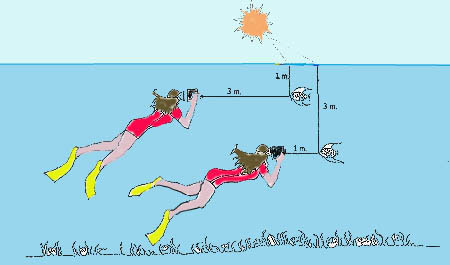
We had not consider that the water of the sea "absorbs"
the colors in proportion to "distance" that exists since photographed
subject. The trouble is that distance means the measuring of the distance
between us and the fish object of our attention added to the distance
of the fish from the surface. For example the absorption of colors will
be the same whether we shoot a fish away to one meter at the depth of
three metres, and if we shoot it from three metres to a depth of one meter
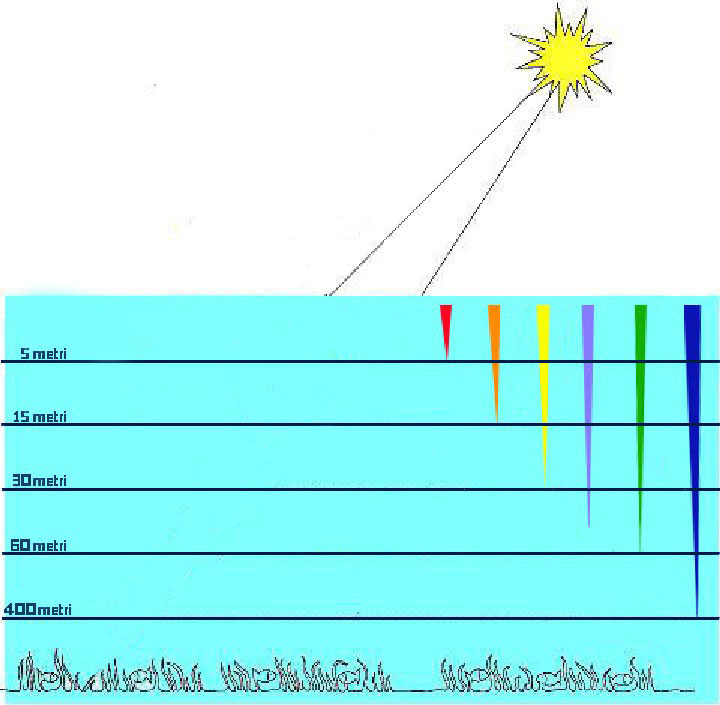
(see illustration above). The absorption is also not equal for all colors,
the first that we lose is the red (just three meters), then we lose orange,
then yellow and so on until blue.
|
 |
|
 |
A solution to retrieve - in whole or in part - the absorbed colors , excluding orange filters that we intend primarily for commercial use, is's the use of the flash. The flash inside the machine is sometimes insufficient, and we should use an external one, even if the equipment becomes more complicated with regard to space and the necessary charging equipment . The external flash, compared to embedded flash, has also another big advantage, the fact that it can be used to illuminate the subject sideways, thus reducing the mass of illuminated water - and consequently the trouble of suspended particles. | |
|
Using however the flash we have not found a definitive
solution, because there are conditions under which it is not recommended
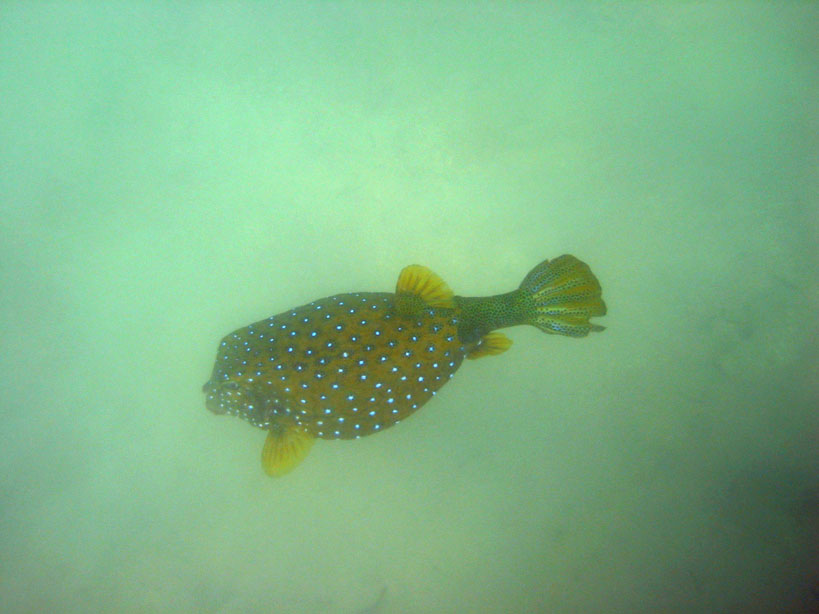
its use, because the water is not quite clear. If we recall, in fact,
the phenomenon of the fog illuminated by the headlights of the car, we
realize immediately that a water with suspended particles visible to the
naked eye, illuminated by the focused light of the flash , creates a more
or less barrier to the photo. To the right there is an example of photo
with flash, Seychelles in 2005, with water not clear. It is also useful
to find out from diving tide time table: depending on the entering or
the exit of the water in the lagoon, water will be more or less clear.
It 's also natural that after a day of big waves, we will have a water
with suspended particles for several hours the following day
|
 |
|
 |
A final element to bear in the end, it is the time when we exit to make snorkeling photo. Not always the sun is in an ideal position to facilitate the underwater photographs: the surface of the water, when hit by a light ray , behaves inform similar to a mirror: leaves spend a certain amount of light, and another amount is reflected, depending on the angle of impact with the surface of the water. The lower reflection, and thus the greater amount of light available below the surface, there will be with the sun on the highest point of the horizon: these are the hours most suitable for photographing, with a light that often allows to don't use the flash, drastically reducing troubles of the photos. |