


|
|
|
|
|
|
|
|
 |
 |
 |
 |
 |
 |
 |
|
THE SNORKELING
|
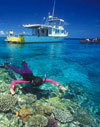 |
Once in the water all things are lighter, even the more or less equipped camera . We have only to watch around and, if we think it appropriate, to photograph what we want. There are no problems, except the currents which we talked before. Before we start to "walk" between fish, therefore, it is a good idea to let support by water without swimming, and to see if we move and at what speed. If there is a weak current , it's always good to start against the tide and to continue until you want to go back with the favourable current. If there is a stronger current , it's more careful to swim out of its scope: normally this is a stream inside the rest of the water mass, and it's enough just to move a few meters for finding much less impetuous currents. It is always valid, naturally, the need to find news by the local diving. | |
|
Sometimes a little of water enters inside the mask
, and disturbs the correct view of ouside. A very effective system to
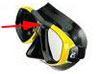
expel the water it is to keep our head out of the water and to press,
with one hand, the mask against the front (as shown in the illustration
on the side), blowing through the nose. The air pushes the water leaked
out from the bottom of the mask. Another disturbing problem it is the
clouding of the lenses. We told before the treatment to be done before
entering the water, but the duration of this protective procedure is time-limited,
and it derives, moreover, from the temperature of the water. In some tropical
seas there are too wide temperature changes in different parts of the
lagoon, and certain currents of cold water into the surrounding mass.
These changes can sometimes cloude the mask and the sub case too.
|
 |
|
 |
A system often used to remove the coluding of the mask, if we don't touch the seabed, it's the deliberate entering of the water in the mask and then removing it with the before described method . We have however to be careful to avoid entering water in the eyes: water it is usually very salty and rich in plankton, which can cause severe heartburn in the eyes, then to be treated with proper drops. It's then preferable to swim until we touch the seabed or the support boat, and to clean the mask there. Moreover it is never too prudent to depart from the low barrier without having the safety of a boat that follows our path, and normally the reef is visible with all its colors in relatively small depths. | |
|
One last thing to remember. In the water we are living
with other beings who are entitled to be respected without being traumatized
by our presence. So we have to be careful about how we move and to don't
touch anything. The fish, if we get too close can be frightening, especially
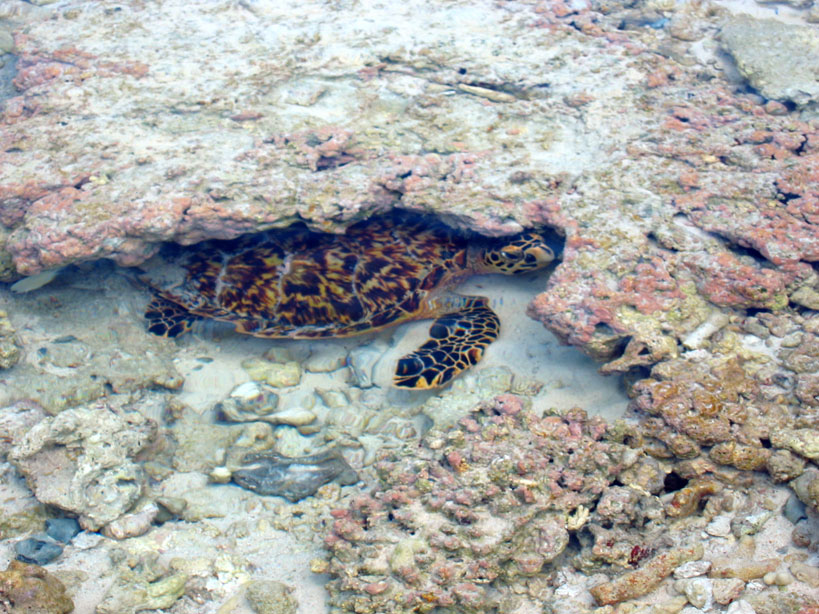
some of them wich are less aggressive. For example, in the lagoons with
low water, depending on the tides can be found turtles that remain closed
within mirrors shallow water and must wait for the highest tide to return
to freedom. We have to remain, even in these cases, far from them, and
to overcome the temptation touch them. And we have also to be careful,
if we walk in shallow waters, where we put our feet: corals are very sensitive
and often there is a very small world that could be destroied by a step.
|
 |
|